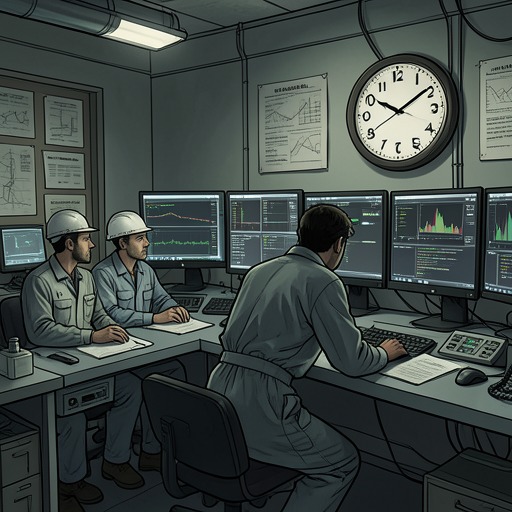
Task Management Team
The Wisdom of CrowdsThe Mission Management Team (MMT) was the NASA group overseeing the space shuttle Columbia’s STS-107 mission. Its handling of a foam strike in January 2003 became a stark example of how a team can receive warnings and still fail to make them matter: managers declined to seek the images engineers said they needed, uncertainty was repeatedly translated into reassurance, and the team never seriously debated the danger before Columbia reentered the atmosphere on February 1.
Mission and warning
On the morning of January 21, 2003, the MMT held its second teleconference since Columbia launched on January 16. An hour earlier, Don McCormack had been briefed by the Debris Assessment Team (DAT), engineers from NASA, Boeing, and Lockheed Martin who had spent much of the preceding five days assessing the effects of a large piece of foam that broke off the external fuel tank’s left bipod area during ascent and struck the shuttle’s left wing. Launch cameras had not captured the impact clearly, leaving the size and consequences of the damage uncertain. A request for on-orbit photographs had been made, but those images had not been approved.
Working with incomplete information, the DAT estimated the foam’s size and impact speed, then used the Crater algorithm to estimate how deeply debris could penetrate the thermal-protection tiles. The engineers had reached no firm conclusion, but they told McCormack there was cause for concern. That concern did not reach the MMT as a clear warning. The foam strike arose only after discussion of a jammed camera, scientific experiments, and a leaky water separator. When MMT leader Linda Ham asked for an update, McCormack said that the damage was being investigated and referred to a similar strike during mission STS-87 five years earlier, which had caused “fairly significant damage.” Ham nevertheless treated the issue as settled: in her view, there was little that could be done, so the strike was not a factor during the flight.
The exchange mattered because the MMT had heard its first details of the strike, but did not receive a full account of possible consequences or what prior debris incidents might show. Ham’s assumption that the problem was inconsequential became the group’s working premise before its members had examined the available evidence together. The book’s account distinguishes this failure from a simple absence of information: the DAT was investigating, and concern existed, but the team did not create a serious route for that concern to shape its deliberation.
From uncertainty to reassurance
The MMT’s approach was practically, though not intentionally, like a verdict-based jury: it moved toward a decision before fully discussing evidence and alternatives. On January 22, Ham e-mailed two team members asking whether any loss of external-tank foam could cause safety-of-flight damage. The desired reassurance was embedded in the question itself. Lambert Austin answered “NO,” and warned that the possibility of serious tile damage could not be ruled out, but his caution attracted little attention. The episode shows how a question can appear to invite analysis while framing the acceptable answer in advance.
A further assumption narrowed the inquiry: if the foam had caused severe damage, perhaps nothing could be done. On January 23, Calvin Schomburg, a technical expert who maintained that the foam could not seriously damage the tiles, argued with Rodney Rocha, the DAT’s unofficial representative, as the engineers grew more concerned about possible burn-through during reentry. Schomburg’s conclusion that nothing could be done reinforced the logic already voiced at the January 21 meeting. But inability to repair damage was not evidence that no danger existed; treating it as a reason to stop investigating further collapsed two distinct questions into one.
On January 24 the DAT presented five possible scenarios. Its overall conclusion was that the shuttle was likely safe, but the engineers emphasized that their analysis was profoundly limited: they did not know precisely where the foam had struck because the MMT had not authorized orbital images, and Crater had been designed for debris hundreds of times smaller than the foam that hit Columbia. The analysis therefore rested on uncertain inputs and a tool whose applicability to this impact was doubtful. NASA management concentrated on the reassuring part of the conclusion rather than on the limits that qualified it.
An hour after the briefing, McCormack summarized the findings to the MMT. He mentioned potential significant damage, said the thermal analysis did not indicate burn-through, and acknowledged uncertainty about the debris’s size, impact location, and angle. Ham again turned the discussion toward reassurance, asking whether no burn-through meant no catastrophic damage and whether the issue was merely a tile replacement or turnaround matter. McCormack said that the team had not yet seen a safety-of-flight issue in what it had examined. Ham then summarized the exchange as confirmation that there was no burn-through or safety-of-flight problem, and asked whether anyone had questions. The meeting ended without examining what the uncertainties meant for the decision.
The silencing of dissent
The January 24 meeting contained no real debate and no visible minority position. McCormack did not present the DAT’s supporting analysis or explain whether its members disagreed about the conclusion. No MMT member asked to see the study; no one asked McCormack to explain or quantify the uncertainties he had mentioned. Ham’s brisk summaries helped close the discussion, turning a limited and qualified engineering assessment into a practical verdict. In this setting, the invitation for questions did not open deliberation so much as signal that the issue should be considered finished.
The same pattern appeared in the handling of imagery. Managers rejected the request for photographs partly on the grounds that image resolution would not reveal the small area struck by foam. Yet, as the Columbia Accident Investigation Board observed, none of the managers had the security clearances needed to know how good the images would be, and none asked the Department of Defense, which would take them, about their quality. The decision was thus made with little or no knowledge of the capability being dismissed, but with considerable assurance. The result was not only that the team lacked a crucial source of information; it also denied the engineers the evidence they needed to improve their assessment.
The team’s settled view encouraged confirmation bias: new information was interpreted to fit the assumption that nothing was wrong. Ham’s January 22 question already contained the answer she appeared to seek, while Austin’s warning that serious damage could not be excluded was largely overlooked. On January 24, the DAT’s explicit caveats did not dislodge the reassuring conclusion extracted from its analysis. The group’s problem was therefore not simply that it lacked data or expertise. It was that its conversational process made it hard for contrary information to alter the decision.
Structure and organizational failure
The MMT’s discussions were both overstructured and understructured. They were overstructured because, on the debris strike and other matters, the pattern was often Ham asking a question and someone answering. They were understructured because no one was systematically asked to comment on specific issues, and no process ensured that all members’ analysis entered the discussion. Good group deliberation needs an agenda and active leadership that makes room for every participant; here, a leader’s questions organized the exchange without creating a broad examination of the evidence.
That failure unfolded within a hierarchical NASA culture. Although the agency could be thought of as meritocratic and bottom-up, the DAT engineers’ early concerns—and their insistence that images were necessary for an informed assessment—never received a serious hearing from the MMT. The engineers possessed specialized knowledge of the strike and of the limits of their tools, but that knowledge did not carry enough weight in the team’s decision process. The book’s broader account of organizations identifies the same structural danger in multilayered corporations: information can be obstructed by the many levels and relationships through which it must travel. The point is not that decentralization itself is a cure. Distributed expertise is useful only if there is a way to bring its findings and judgments together.
The contrast with collective problem solving elsewhere in the book clarifies the MMT’s failure. During the international search for the cause of SARS, laboratories worked in parallel, shared results, and revised their hypotheses through recurring exchanges. No single authority dictated every task, but the network had mechanisms for information to circulate and for separate work to contribute to a shared conclusion. In the MMT, by contrast, the engineers’ local analysis and uncertainty were not effectively aggregated into the group’s judgment. The episode therefore illustrates a distinction between decentralization and fragmentation: specialized work can strengthen an organization, but only when information and disagreement can move across its parts.
Significance and outcome
The MMT’s failure cannot be explained away as the inevitable product of hindsight. The book cautions that retrospective criticism can make danger seem easier to recognize than it was in real time, as it also does when assessing intelligence failures. Yet the team had opportunities to make different choices that could have improved the crew’s chance of survival. Members were urged to collect information needed for a reasonable safety estimate; the foam could potentially have caused burn-through; and even the team’s leaders raised the possibility that the damage was severe. Still, the MMT never came close to making the right decision about what to do.
By the time the January 24 meeting ended, uncertainty had not been resolved so much as converted into confidence without adequate examination. The team had not seen the requested images, had not considered the DAT’s supporting analysis as a group, and had not tested the assumptions behind the reassuring interpretation. Columbia reentered the atmosphere on February 1. In the book’s analysis, the significance of the MMT lies in the gap between having experts and using their knowledge: a team is not collectively intelligent merely because its members possess relevant information. It must also permit dissent, expose uncertainty, and connect specialized judgments to a shared decision.